
Oral and Maxillofacial Surgery MCQs

MCQs on Mandibular Fractures and Middle Third of Face Fractures

Welcome to your MCQs on Mandibular Fractures and Middle Third of Face Fractures

1. 
A 42-year-old male is brought to the emergency department following a high-speed road traffic accident. He has sustained severe maxillofacial trauma with multiple facial fractures, profuse oral bleeding, and swelling of the soft tissues. The patient is restless, cyanosed, and making gurgling sounds while breathing. What is the most immediate life-threatening danger in this patient?

2. 
A 30-year-old male is brought to the emergency department after a severe road traffic accident. He presents with massive facial edema, bilateral periorbital ecchymosis, lengthening of the face, and mobility of the entire midface along with the zygomatic complex. Clinical examination suggests separation of the facial skeleton from the cranial base. This type of craniofacial dysjunction is characteristic of which fracture?

3. 
A 26-year-old male presents after being struck in the left eye during a sports injury. He complains of diplopia, periorbital swelling, and pain on upward gaze. A Waters radiograph demonstrates a “hanging drop” or “teardrop” appearance projecting into the maxillary sinus. This radiographic finding is most indicative of:

4. 
A 24-year-old male presents to the emergency department with a deep facial laceration sustained during a road traffic accident. The wound is clean with minimal contamination, and the oral and maxillofacial surgeon plans primary closure to achieve optimal esthetic healing and reduce the risk of infection. Within what time period should suturing of facial wounds ideally be performed?

5. 
A 29-year-old male presents after facial trauma sustained during a road traffic accident. He complains of double vision (diplopia), pain around the cheekbone, and flattening of the malar prominence. Clinical examination reveals periorbital edema and restricted upward gaze. Radiographic evaluation confirms a fracture involving the zygoma and orbital floor. Diplopia is most commonly associated with which of the following fractures?

6. 
A 28-year-old male presents after facial trauma with complaints of numbness over the cheek, upper lip, and lateral side of the nose. Clinical examination reveals flattening of the malar prominence and periorbital ecchymosis. Radiographic findings confirm a fracture involving the zygomatic complex. Paresthesia in this patient is most commonly associated with which type of fracture?

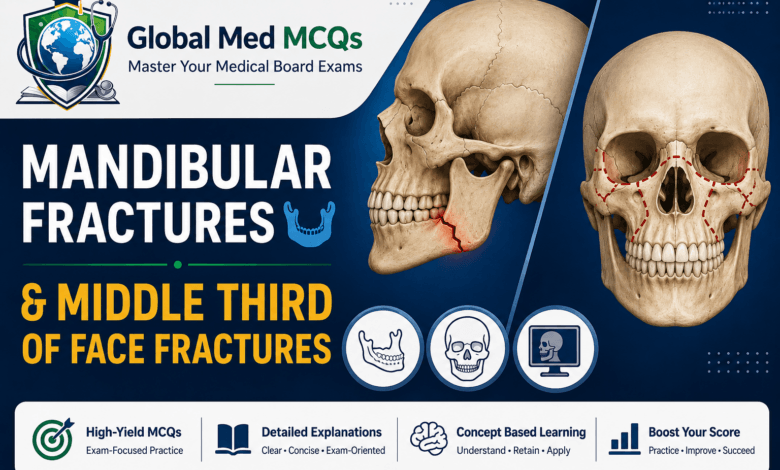
Prepare effectively for FCPS, BDS, MBBS, MDS, and other medical and dental board examinations with this high-yield collection of MCQs on Mandibular Fractures and Middle Third of Face Fractures. This quiz is designed to help students strengthen their understanding of maxillofacial trauma, fracture patterns, clinical signs, radiographic diagnosis, and management principles commonly tested in competitive and professional examinations.

These exam-oriented MCQs cover important topics including:

  • Mandibular fractures
  • Condylar fractures
  • Symphysis and angle fractures
  • Zygomaticomaxillary complex fractures
  • Le Fort fractures
  • Orbital blowout fractures
  • Craniofacial dysjunction
  • Clinical features and complications
  • Radiographic interpretation
  • Emergency management of facial trauma

Each question is structured in a board-style format to improve conceptual understanding and exam-solving skills for oral and maxillofacial surgery trauma topics.

What You Will Learn

  • Important mandibular fracture patterns
  • Middle third facial fracture classifications
  • Clinical signs and symptoms of facial trauma
  • Radiographic views used in diagnosis
  • Emergency management principles
  • Frequently repeated board exam concepts

Leave a Reply

Your email address will not be published. Required fields are marked *

error: