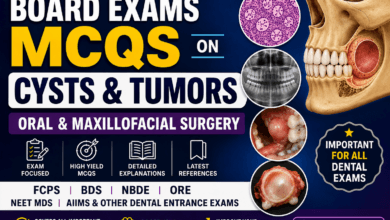
Board Exam MCQs on Odontogenic Cysts and Tumors – Oral and Maxillofacial Pathology

Board Exam MCQs on Developmental Disturbances of Orofacial Region
Practice. Review mistakes. Master the exam.
How would you like to study?
Start practising
0 correct · 0 incorrect · 0 answered
📚 Introduction
Odontogenic cysts and tumors are important topics in oral pathology, oral surgery, and dental board examinations. They commonly appear in FCPS, BDS, NBDE, ORE, NEET MDS, and other dental licensing examinations.
This practice set contains clinically oriented, scenario-based MCQs covering the diagnosis, histopathology, radiographic features, syndromic associations, and management of odontogenic cysts and tumors.
Topics Covered
- Odontogenic keratocyst
- Dentigerous cyst
- Radicular and residual cysts
- Ameloblastoma
- Adenomatoid odontogenic tumor
- Calcifying epithelial odontogenic tumor
- Simple bone cyst
- Eruption cyst
- Gorlin–Goltz syndrome
- Histopathological features of odontogenic lesions
Each question includes five answer choices, the correct answer, a concise explanation, and an exam-oriented hint.
Exam Tip: Pay special attention to the relationship between clinical presentation, radiographic appearance, histopathological findings, and recurrence potential.
🎯 Who Should Practice These MCQs?
These questions are useful for:
- FCPS Part 1 Dentistry
- BDS University Examinations
- NBDE and INBDE
- ORE
- NEET MDS
- AIIMS Dental Examinations
- Dental licensing examinations
- Oral and Maxillofacial Surgery preparation
- Oral Pathology revision
Frequently Asked Questions (FAQs)
What are odontogenic cysts and tumors?
Odontogenic cysts and tumors are lesions that develop from tissues involved
in tooth development. They may arise from odontogenic epithelium, dental
lamina remnants, or other tooth-forming tissues. Their clinical behavior
ranges from benign and slow-growing to locally aggressive.
Which is the most common odontogenic cyst?
The radicular cyst is generally considered the most common odontogenic
cyst. It usually develops at the apex of a non-vital tooth due to
inflammation and proliferation of epithelial rests of Malassez.
Which odontogenic lesion has a high recurrence rate?
Odontogenic keratocyst (OKC), also called keratocystic odontogenic tumor
in older classifications, is known for its recurrence potential. Satellite
or daughter cysts, epithelial remnants, and the thin friable lining may
contribute to recurrence.
What are the characteristic histological features of ameloblastoma?
Conventional ameloblastoma commonly shows peripheral palisading of
columnar or cuboidal cells with reverse nuclear polarization and central
stellate-reticulum-like cells. Common histological patterns include
follicular and plexiform types.
What is a dentigerous cyst associated with?
A dentigerous cyst is associated with the crown of an unerupted tooth and
is attached near the cemento-enamel junction. It is commonly associated
with impacted mandibular third molars, maxillary canines, supernumerary
teeth, and odontomas.
What is the characteristic feature of an adenomatoid odontogenic tumor (AOT)?
AOT is a benign odontogenic tumor that may be associated with an unerupted
tooth, especially a canine. Histologically, it commonly contains
duct-like or tubular structures formed by epithelial cells and may show
calcified material.
What is the difference between a true cyst and a pseudocyst?
A true cyst has an epithelial lining surrounding its cavity. A pseudocyst,
such as a simple or traumatic bone cyst, lacks an epithelial lining.
This distinction is frequently tested in Dental Board and FCPS examinations.
How are odontogenic cysts and tumors diagnosed?
Diagnosis is based on clinical examination, radiographic findings, and
histopathological evaluation. Imaging helps determine the lesion’s
location and extent, while biopsy and microscopic examination may be
necessary for definitive diagnosis.
How are odontogenic tumors treated?
Treatment depends on the lesion’s diagnosis, size, location, recurrence
risk, and biological behavior. Options may include enucleation,
curettage, decompression, or surgical resection. Locally aggressive
lesions may require more extensive treatment.
Who should practice these Odontogenic Cysts and Tumors MCQs?
These clinically oriented MCQs are useful for students and candidates
preparing for FCPS Dentistry, BDS examinations, NBDE, INBDE, ORE,
NEET MDS, AIIMS, and other dental licensing examinations.
&